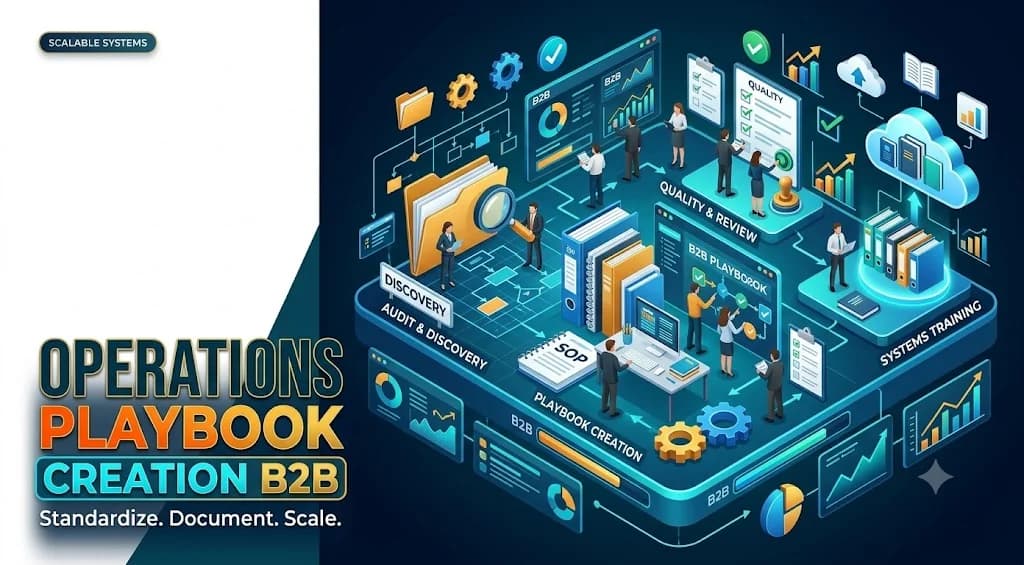
The Infrastructure of Scale: Why Your B2B Needs an Operations Playbook
In software engineering, code written without documentation leads to technical debt, system bottlenecks, and broken builds. In B2B operations, unstructured processes create operational debt, missed SLAs, and execution friction across teams. An operations playbook serves as your enterprise’s source code—a clear, centralized, and executable set of instructions that translates business strategy into repeatable operational outputs.
As B2B organizations scale sales, customer success, and product delivery, relying on tribal knowledge creates severe single-point-of-failure risks. When key team members depart, operational continuity degrades. Building a structured B2B operations playbook mitigates this risk by driving SOP standardization, establishing clear accountability, and codifying organizational best practices. Approaching playbook creation as a system engineering effort ensures operational efficiency, resilience, and deterministic business performance.
Structuring Your Playbook: Modular Architecture and Mapping
A high-performing operations playbook must be structured modularly—much like clean, microservices-based software architecture. Rather than compiling a monolithic document that remains unread, split your enterprise operations into functional, interlinked modules.
Key strategies for architecting your B2B operational hub include:
- Process Mapping: Visually document every B2B workflow from trigger to final output, identifying dependencies, inputs, and operational handoffs.
- SOP Standardization: Format every standard operating procedure with standardized parameters: Objective, Required Tools, Responsible Role (RACI matrix), Step-by-Step Instructions, and Definition of Done.
- Single Source of Truth: Host playbooks in a dynamic, searchable workspace (such as Notion, Confluence, or internal wikis) rather than static PDF files.
- Version Control & Ownership: Treat operational updates like code releases. Assign process owners, maintain continuous update logs, and perform quarterly workflow reviews to eliminate process drift.
Operationalizing the Playbook: Automation and Adoption
Documenting workflows is only the initial step; consistent execution generates measurable ROI. A playbook that exists in isolation without integration into daily B2B workflow systems rapidly becomes obsolete technical documentation.
To maximize playbook adoption and operational throughput, implement these core operational principles:
- Integrate Business Process Automation: Embed direct links to automation scripts, CRM macros, and workflow integration tools directly inside task instructions to reduce context switching.
- Contextual Task Delivery: Surface relevant SOP links inside active task management platforms (e.g., Jira, Asana) so employees access instructions directly at point of execution.
- Feedback Loops: Enable inline commenting and change-request mechanisms so front-line team members can continuously propose optimizations to workflow procedures.
- Audit & Telemetry: Establish key performance indicators (KPIs) for critical processes. Periodically audit execution compliance to identify and resolve systemic bottlenecks.
Continuous Refinement: Scaling Your Operational Stack
An enterprise operations playbook is a living system. Just as production software requires ongoing monitoring, refactoring, and continuous deployment, your operational framework must evolve alongside business expansion. Cultivating a culture rooted in systematic documentation, recurring process audits, and automated execution builds a scalable execution layer capable of handling rapid enterprise growth without sacrificing delivery quality.
Transitioning from ad-hoc workflows to a structured, scalable execution engine is the most dependable path to long-term B2B profitability. Treat your operations like codebase architecture—build it cleanly, iterate constantly, and scale reliably.
Ready to optimize your business process architecture? Reach out to our operational systems specialists today to audit your workflows, implement standard SOP structures, and deploy a high-efficiency B2B operations playbook built for enterprise scale.