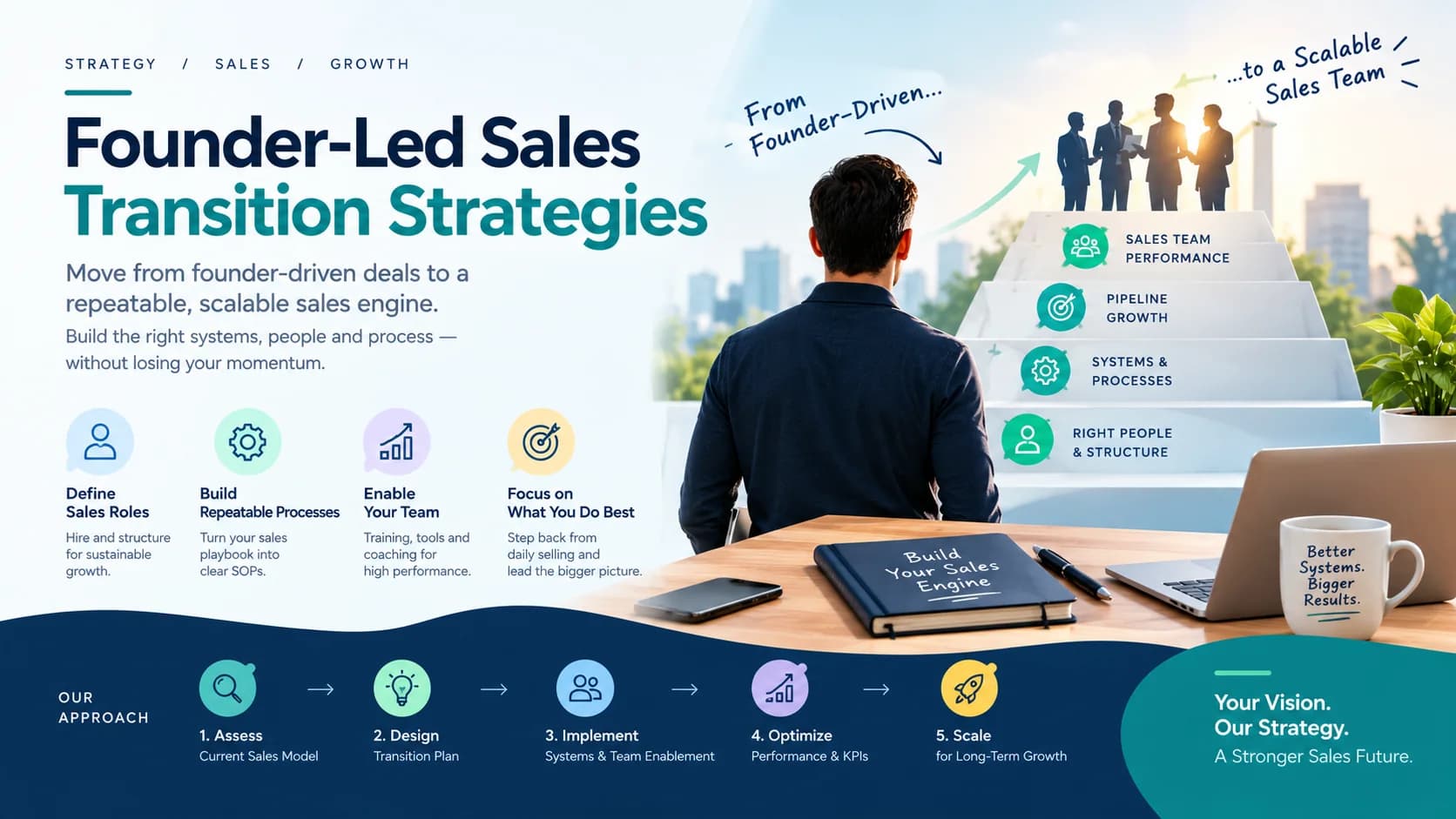
Transitioning away from founder-led sales is one of the most critical inflection points in a company’s lifecycle. In the early stages, founders drive revenue through sheer domain expertise, technical passion, and personal conviction. You know every line of code, every edge case, and every business value proposition intuitively. However, relying indefinitely on founder-led sales creates a hard ceiling on growth. You become the single point of failure in your pipeline.
Scaling revenue requires treating your sales process like a software architecture: it must be modular, documented, and capable of running without founder intervention. Shifting from organic, founder-driven deals to a repeatable sales machine demands a structured operational strategy. If you do not decouple your revenue engine from your personal schedule, your ability to focus on product vision, hiring, and strategic execution will deteriorate. This guide outlines how to systematically transition out of primary sales while maintaining close rates, preserving your brand’s integrity, and accelerating ARR growth.
Step 1: Codify the Sales Algorithm into a Repeatable Playbook
Before bringing on your first sales hires, you must extract the implicit knowledge in your head and turn it into explicit documentation. Founders often sell based on intuition, adjusting their pitch dynamically during live calls. Sales reps cannot replicate intuition—they need a deterministic framework.
- Define a Precise Ideal Customer Profile (ICP): Document exactly who buys, who uses, and who approves the budget. Specify hard qualification triggers and clear disqualification rules.
- Standardize the Discovery Matrix: Map out the exact technical and business questions required to expose customer pain points. Provide explicit logic branches for common objections.
- Build the Asset Library: Centralize battle cards, case studies, security overview docs, and ROI calculators so reps do not need to improvise collateral.
- Document Pipeline Stages: Define mandatory exit criteria for every pipeline stage (e.g., Stage 2 to Stage 3 requires a confirmed technical validation doc signed off by the prospect).
Treating your sales playbook like clear documentation ensures that new team members can execute sales cycles with consistent, predictable output.
Step 2: Sequence Hiring and Implement Systemic Telemetry
A common mistake when stepping back from sales is hiring an expensive, enterprise sales executive too early. Early-stage transitions require adaptable executors—frequently referred to as pioneer reps—who can test your playbook in real-world scenarios, discover edge cases, and provide structured feedback to refine the system.
- Hire Reps in Pairs: Deploy two sales reps simultaneously. This isolates individual variables, helping you quickly distinguish between process flaws and performance gaps.
- Establish CRM as the Single Source of Truth: Every call log, meeting record, email sequence, and deal stage must be logged deterministically in your CRM. If it is not recorded in the CRM, it did not happen.
- Execute a Phased Hand-off:
- Founder-Led, Rep-Observed: The rep shadows your calls and logs metrics.
- Rep-Led, Founder-Supported: The rep conducts the call; you step in only for high-level technical or strategic validations.
- Autonomous Execution: The rep handles the full deal lifecycle while you conduct pipeline reviews.
By embedding telemetry into your workflow, you maintain complete visibility into conversion rates and sales velocity without micromanaging daily calls.
Conclusion: Scaling Beyond the Founder
Transitioning from founder-led sales is not an elimination of the founder’s involvement, but a transformation of their role. You move from being the primary deal closer to acting as executive sponsor for key accounts and chief architect of the revenue engine.
By codifying your domain knowledge into a clear playbook, hiring pioneer reps in pairs, and establishing rigorous CRM tracking, you build a resilient go-to-market strategy that scales independently. This strategic shift allows your organization to unlock predictable revenue growth, expand total addressable market coverage, and free up vital leadership bandwidth.
Ready to optimize your sales architecture? Evaluate your current deal pipeline, audit your sales documentation, and begin building a scalable revenue engine today.