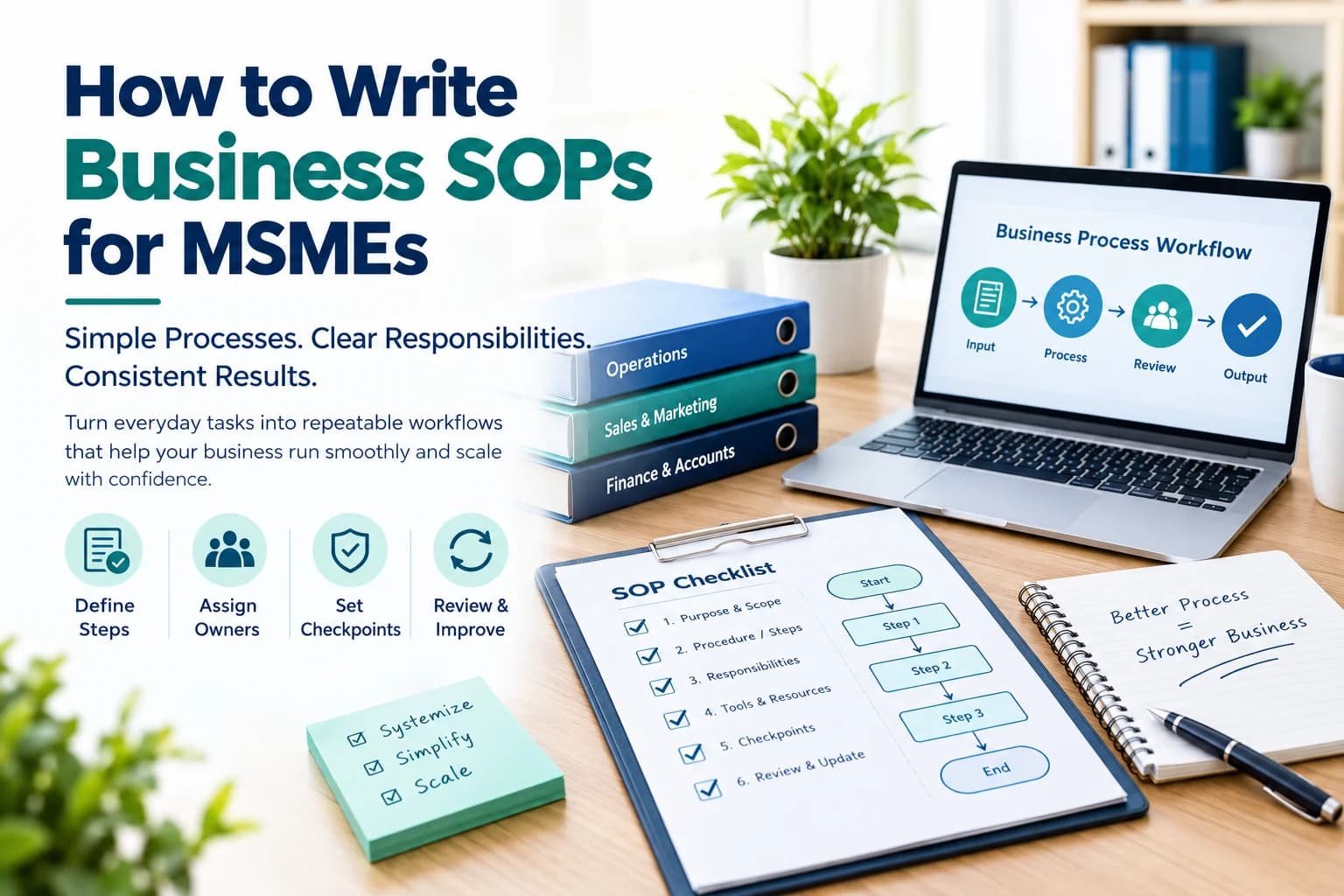
Micro, Small, and Medium Enterprises (MSMEs) often run on tribal knowledge—critical business processes stored entirely in the minds of key team members. While this agility works in the early days, it creates severe operational bottlenecks as you scale. Writing Standard Operating Procedures (SOPs) is the ultimate strategy to transform tribal knowledge into predictable, repeatable systems.
Think of SOPs as clear, human-executable scripts. When documented properly, they allow anyone on your team to execute complex tasks consistently, reducing manual errors, lowering training overhead, and preserving operational efficiency. For growing MSMEs, SOPs are not bureaucratic red tape; they are the bedrock of scalability and long-term enterprise value.
In this guide, we break down a structured, direct framework to map, write, test, and deploy business SOPs that your team will actually adopt.
1. Map Core Workflows and Define Scope
Before writing a single instruction, audit your daily operations to identify high-impact processes that require standardization. Focus on tasks that are repeated frequently, prone to human error, or critical to customer satisfaction.
- Define Clear Inputs and Outputs: Every process takes specific inputs (e.g., a raw customer ticket) and produces defined outputs (e.g., a resolved support issue). Outline these boundaries before writing steps.
- Choose the Right Format: Match the format to the complexity. Use Checklists for simple sequential routines, Flowcharts for decision-heavy workflows, or Hierarchical Text Documents for technical policies.
- Assign Process Ownership: Designate a single subject matter expert—someone who routinely performs the task—to draft or assist in documenting the workflow.
By scoping the workflow tightly, you prevent documentation bloat and keep instructions clear, direct, and easy to maintain.
2. Draft Actionable Steps and Test for Bugs
The secret to effective process documentation lies in clarity and precision. Avoid vague statements and write explicit, action-oriented instructions.
- Use Imperative Action Verbs: Begin every step with a clear command (e.g., "Export the weekly sales report into CSV format," rather than "The report should be exported").
- Keep Steps Modular: Break complex operations into small, logical sub-steps. If a task contains more than two conditional paths, branch it into a simple decision matrix or standalone sub-SOP.
- Perform QA Testing (Peer Review): Test your draft like code. Pass the written SOP to a team member who does not handle the role daily. Have them execute the task strictly following the written instructions, without verbal hints.
- Enforce Version Control: Document creation dates, author names, and revision history (e.g., v1.0, v1.1) to ensure the team always executes the latest process iteration.
Fix any ambiguities or missing steps identified during your peer test before releasing the SOP to your main business library.
3. Maintain and Automate Your SOP Library
Creating SOPs is not a static project; it is a continuous operational loop. As your MSME adopts new software tools or refines business strategies, your documentation must evolve alongside your business operations.
Establish a bi-annual review schedule where process owners review active SOPs for relevance and accuracy. Encourage an open feedback loop where employees can log updates or report operational friction whenever they encounter outdated instructions.
Once processes are standardized, look for opportunities for workflow automation. Digital tools and software integrations can automate repetitive steps within your SOPs, freeing up human bandwidth for strategic growth.
Ready to systematize your MSME? Select one high-friction process in your business today, gather your inputs, and write your first draft using this structured framework.