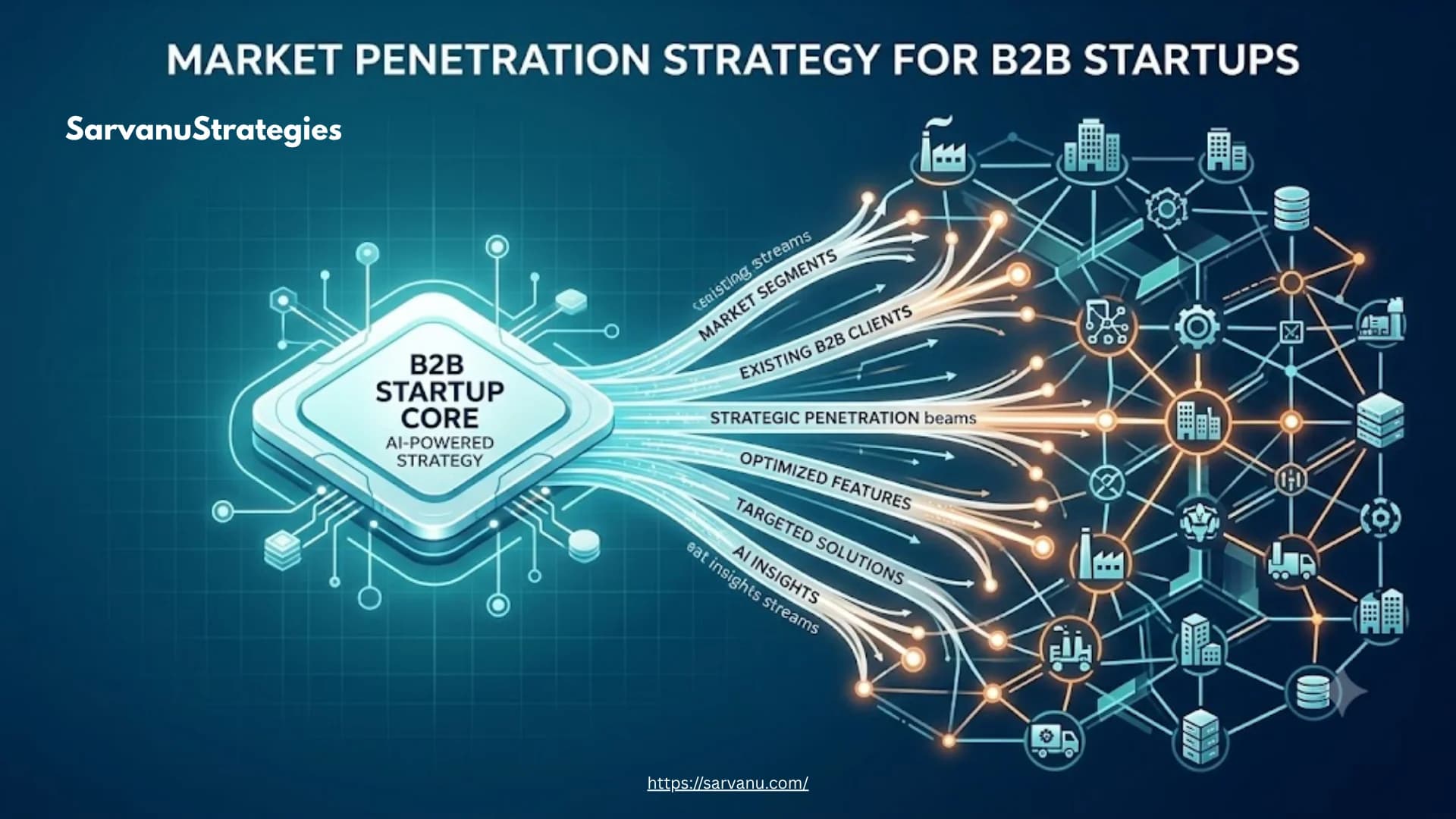
Deconstructing the Cold Start Problem in B2B
In software architecture, solving a cold start problem requires warming up resources before traffic spikes hit production. Breaking into an established B2B market follows the identical paradigm. Market penetration represents the focused effort to capture market share for an existing product within an already recognized category. For an early-stage B2B software venture, facing legacy enterprise vendors with deep moats and multi-year procurement cycles can feel like attempting to query an unindexed billion-row database.
A successful market penetration strategy does not rely on brute-force marketing spend or unoptimized outbound campaigns. Instead, it demands systematic identification of low-friction entry vectors, deliberate pricing architecture, and continuous reduction of customer time-to-value (TTV). By treating your go-to-market motion as an iterative deployment pipeline rather than an ad-hoc exercise, you turn early market resistance into predictable expansion velocity.
Phase 1: Securing the Beachhead via Tight ICP Segmentation
The most common failure mode for B2B founders is targeting an addressable market that is too wide. Attempting to build horizontal solutions out of the gate creates bloat and dilutes your value proposition. Effective market penetration begins by defining a micro-segmented Ideal Customer Profile (ICP) and dominating that beachhead market.
- Isolate High-Pain Subsegments: Pinpoint enterprise teams actively seeking to replace legacy workflows due to regulatory, technical, or cost pressures.
- Engineer High-Precision Ingestion: Optimize your onboarding funnel like a high-throughput API. Remove arbitrary enterprise barriers such as mandatory sales demos for low-tier users.
- Deploy Aggressive Value-Tier Pricing: Leverage penetration pricing or freemium self-serve tiers to lower organizational switching friction without devaluing the core product.
- Target Incumbent Vulnerabilities: Identify slow, bloated enterprise incumbents and solve their weakest functional link with exceptional UX and rapid execution.
By capturing 15% to 20% of a tightly defined niche, your startup establishes immediate social proof, builds domain-specific reference architecture, and generates the case studies necessary to bridge upward into larger accounts.
Phase 2: Executing the Land-and-Expand Product Flywheel
Once initial penetration occurs within an organization, your operational objective transitions immediately from acquisition to retention and expansion. In enterprise B2B environments, closing an initial seat or departmental license is merely opening a connection socket; the actual lifetime value (LTV) materializes through account proliferation.
- Embed Native Workflow Hooks: Integrate deeply with existing tech stacks (e.g., identity providers, ticketing systems, internal communication channels) to raise switching costs naturally.
- Trigger Expansion Mechanics: Use product-usage telemetry to flag accounts nearing tier limits, enabling customer success to prompt automated, high-conversion upsells.
- Incentivize Team-Based Collaboration: Design product features that require cross-departmental invitations, driving organic viral loops within the customer's enterprise boundaries.
- Deliver Measurable ROI Telemetry: Provide internal champions with automated reporting dashboards that prove capital or efficiency savings to procurement boards.
By building expansion logic directly into your product workflows, your customer acquisition cost (CAC) decreases proportionally as customer lifetime value compounds.
Instrumentation, Iteration, and Sustainable Scale
A resilient market penetration strategy is fundamentally metric-driven. You cannot optimize what you do not measure. Founders must construct real-time executive dashboards monitoring three core performance vectors: Net Revenue Retention (NRR), CAC Payback Period, and Sales Cycle Velocity. If your CAC payback period exceeds 14 months in the early stages, your penetration vector is too broad or your value proposition is misaligned with enterprise buyers.
As your startup reaches critical density inside your beachhead segment, standardize your sales playbooks, institutionalize feedback loops directly into your engineering roadmap, and prepare for broader market adjacent moves. Market penetration is not a singular launch event—it is an algorithmic process of identifying leverage points, deploying high-utility solutions, and methodically claiming operational ground.