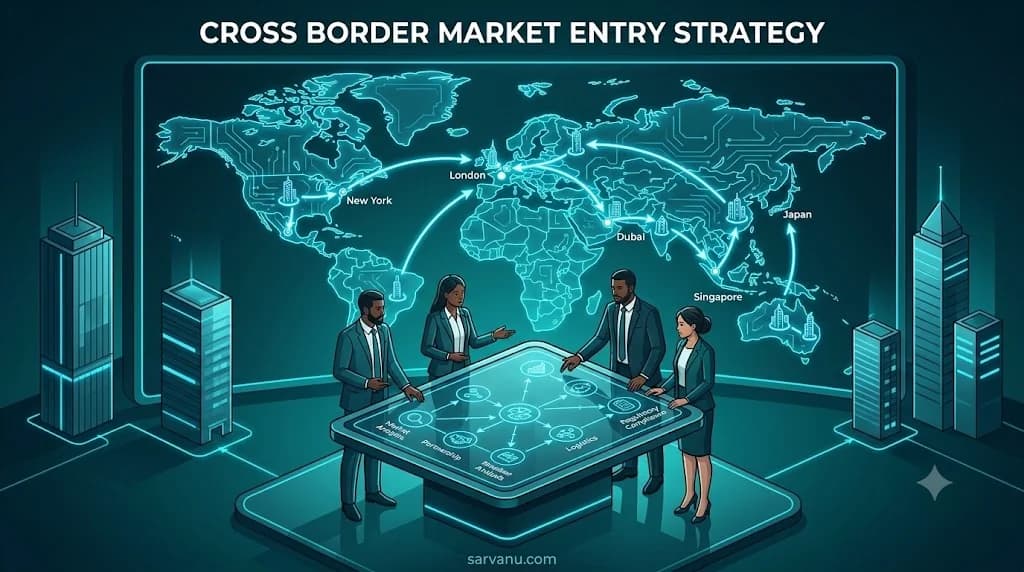
Listen up: if your software or ecommerce stack is still geofenced to your home turf, you are bleeding ARR every single minute. The global digital economy isn't waiting for your next sprint retrospective. International users are looking for your solution right now, but while you hesitate, competitor teams are spinning up multi-region clusters and eating your target market share alive. Building a cross border market entry strategy isn't a fluffy corporate exercise anymore—it is an urgent operational sprint. Think of global expansion like refactoring legacy architecture for horizontal scale: you isolate the variables, deploy edge infrastructure, automate compliance, and blast off. The window of opportunity across untapped emerging markets is closing fast. Let’s look at the production-ready blueprints to push your business global before midnight.
1. Infrastructure First: Latency Kills Global Conversions
You wouldn’t run an unindexed SQL query in production, so why force international shoppers to ping a single data center halfway across the planet? Performance is revenue. When crossing borders, technical localization is your first line of defense. If your localized landing page takes longer than two seconds to load in Tokyo, Berlin, or São Paulo, your checkout bounce rate skyrockets past 60%. Here is your Day-Zero technical checklist:
- Edge CDN & Serverless Routing: Deploy on modern edge networks (like Cloudflare or Fastly) to serve static assets and cached microservices directly adjacent to your international target users.
- Dynamic Currency & Pricing Engines: Swap static price tables for dynamic, localized multi-currency microservices that recalculate conversions, taxes, and import duties in real-time.
- Sub-resource Integrity for Multilingual Content: Implement headless CMS workflows that decouple raw string translations from your frontend UI. Never hardcode international copy into your codebase.
Global markets reward speed. Optimize your time-to-first-byte (TTFB) on an international scale, and you instantly convert incoming traffic at double the industry average.
2. Decouple Payments, Compliance, and Cross-Border Logistics
Building the front-end is the easy part. The real bottleneck that crashes international expansion attempts is hard-coding local compliance, tax models, and payment rails. Local buyers will immediately bounce if their preferred local payment methods (LPMs)—like Pix in Brazil, iDEAL in the Netherlands, or UPI in India—aren't integrated into the checkout flow. Credit cards simply do not rule the world.
Treat your global checkout like a plugin architecture. Integrate orchestrators that abstract cross-border complexities:
- Modular Payment Gateways: Leverage unified payment processors with native routing to bypass massive cross-border interchange fees and skyrocket payment authorization rates.
- Automated Tax & Duty Calculation: Use drop-in APIs to automatically calculate VAT, GST, and landed costs upfront so your customers never face surprise import clearance fees at customs.
- Regulatory Sandboxing: Treat data privacy (GDPR, LGPD, CCPA) as core code compliance. Store user PII in local regions to avoid catastrophic regulatory penalties.
- Fulfillment & 3PL Integrations: Connect your inventory management directly with regional third-party logistics endpoints to slash international delivery times from three weeks down to two days.
3. Push to Main: Your 30-Day Go-Live Sprint
Stop overanalyzing 80-page marketing decks. Market entry demands rapid prototyping and ruthless execution. You don't need boots on the ground in ten countries at once; you need an agile, test-driven entry strategy. Pick one high-affinity foreign territory, launch an MVP localized checkout, and monitor the telemetry.
Track your international metrics exactly like system monitoring alerts:
- Payment Conversion Velocity: Are auth rates dropping in specific regions? Fix routing rules immediately.
- Localized Acquisition CAC: International PPC and localized social channels often cost 70% less than saturated domestic feeds—capitalize on these cheap clicks instantly.
- Localized Net Promoter Score (NPS): Pay close attention to international return requests and localized customer support friction points.
The runway is clear, and modern API tools make global deployment faster than ever. Every day you wait to execute your cross border market entry strategy is another day you hand out market dominance to a faster competitor. Branch off, build the pipeline, run the tests, and push your global storefront to production right now!